Critical raw materials: new Commission’s Action Plan

On 3 September, the European Commission published an Action Plan on Critical Raw Materials (including the 2020 List of Critical Raw Materials) and a foresight study on critical raw materials for strategic technologies and sectors.

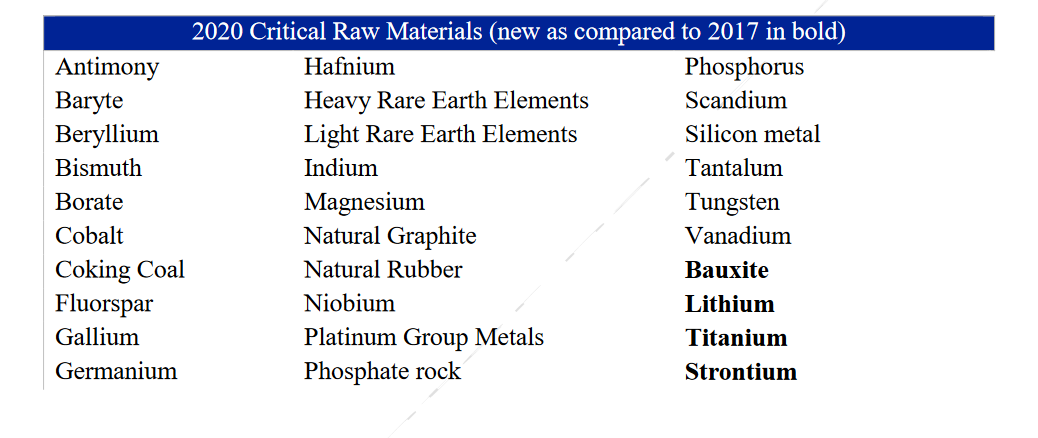
Critical raw materials are defined as materials that are important economically and have a high supply risk. For instance, tungsten, gallium, indium, silicon metal, and lithium are all part of the list of critical raw materials.

The aim of this Action Plan is to reduce Europe’s dependency on third countries for critical raw materials and improve circularity and resource efficiency. The Commission underlines that this is a strategic security question for Europe.

This issue is becoming even more urgent in the context of the green transition, where reliance on fossil fuels is often replaced with reliance on raw materials. For instance, for electric vehicle batteries and energy storage, it is estimated that the EU would need up to 18 times more lithium and 5 times more cobalt in 2030, compared to the current supply of the whole EU economy. Demand for rare earths, used for electric vehicles, digital technologies and wind generators, could increase tenfold by 2050. The Action Plan also adds that “the burden of curbing emissions to other parts of the economic chain may simply cause new environmental and social problems, such as heavy metal pollution, habitat destruction, or resource depletion”.

Please find below the link to the Action Plan and a summary of the document.

Action Plan on Critical Raw Materials

2020 List of Critical Raw Materials

The first List of Critical Raw Materials was established in 2011. The European Commission reviews the list every three years. For this 2020 list, bauxite, lithium, titanium and strontium are added for the first time.

A high dependency on third countries

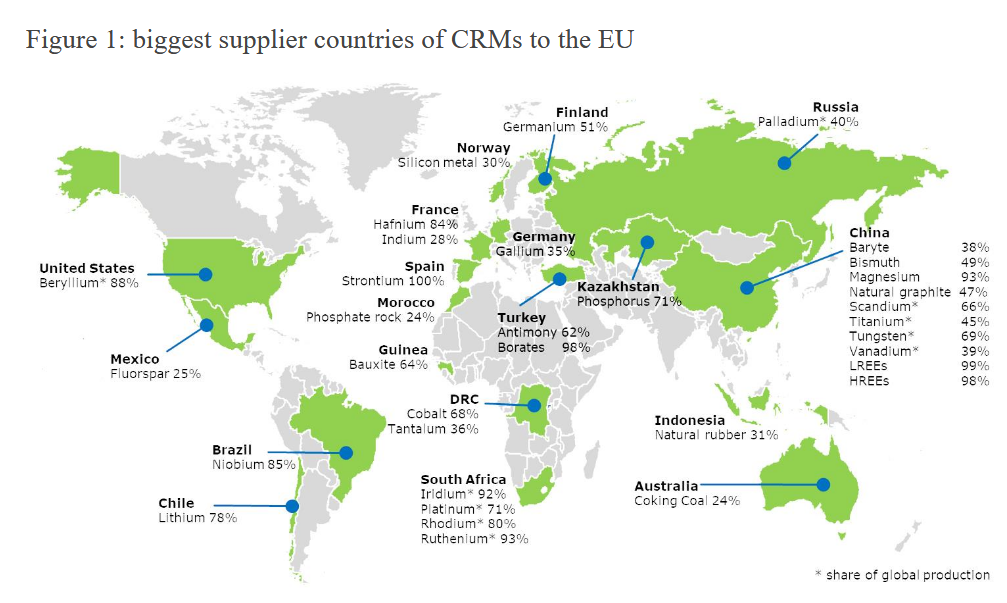
Europe is heavily relying on third countries for the supply of critical raw materials. It is between 75% and 100% reliant on imports for most metals.

For instance, China provides 98% of the EU’s supply of rare earth elements, Turkey provides 98% of the EU’s supply of borate and Africa provides 71% of the EU’s supply of platinum. When it comes to hafnium and strontium, the EU relies on single EU companies.

In addition, Europe sometimes misses the necessary skills for refining and metallurgy. This is the case for lithium, which is mined in Europe but leaves Europe for processing.


Increasing resilience of value chains

Some efforts have already been made to increase supply capacity in the EU. The European Battery Alliance has mobilised public and private investment, and 80% of Europe’s lithium demand should be met by European sources by 2025.

The European Commission wants to deepen this by launching a European Raw Materials Alliance in Q3 2020. This new Alliance will first focus on EU resilience in the rare earths and magnets value chain (vital for renewable energy, defence and space). It will then expand to cover other critical raw materials. The Alliance will be open to all relevant stakeholders, including industrial actors along the value chain.

Furthermore, the European Commission aims to diversify sourcing from third countries. For instance, it will use international trade agreements and integrate the Western Balkans into EU supply chains (Serbia for borates, Albania for platinum deposits).

It will also work to shift EU import payments for critical raw materials from other international currencies (e.g. US dollar) to the euro. This would reduce price volatility and make the EU and third country exporters less dependent on US dollar funding markets.

In addition, the European Commission will develop a sustainable finance taxonomy to guide public and private investments towards sustainable activities.


Circular use of resources

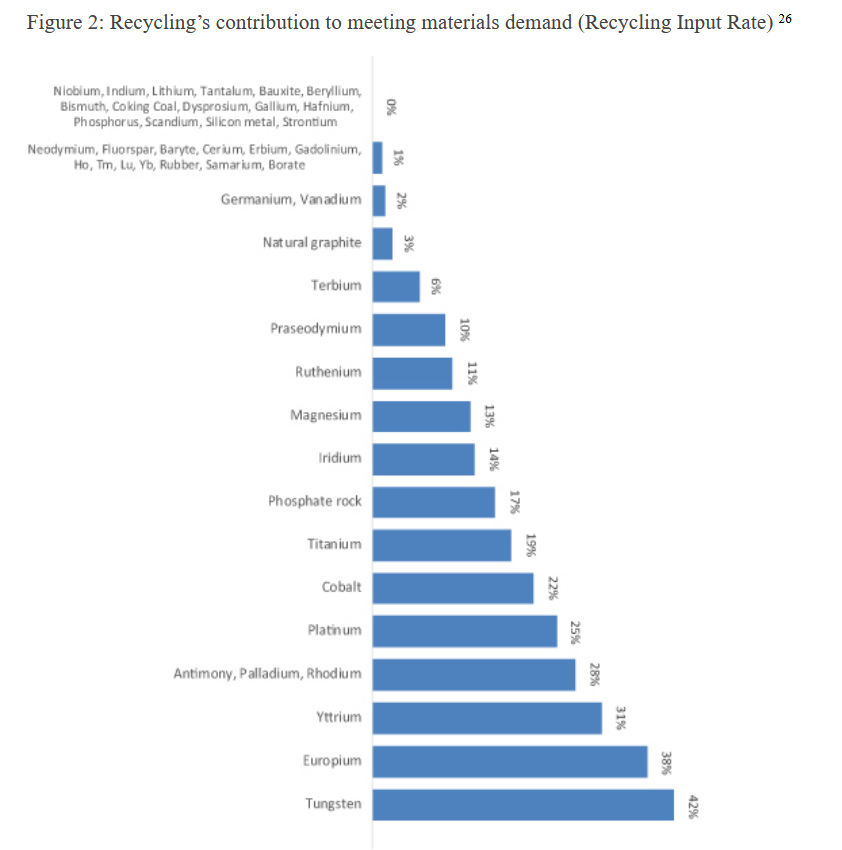
The European Commission also aims to improve sustainable product design and use of secondary raw materials. Horizon Europe and other funding programmes will be used for this purpose.

The Commission will propose a new regulation addressing end-life phase, collection rates, recycling and producer responsibility for batteries by October 2020.

Sourcing from the EU

The European Commission plans on fostering the transition of regions heavily dependent on coal or carbon-intensive industries to mining and processing of critical raw materials, especially for batteries. Many of the mining and engineering skills are transferable to the exploitation of metals and minerals which are often in the same region.

Thus, the EU will identify mining and processing projects and investment needs and related financing opportunities for critical raw materials in the EU with priority for coal-mining regions.


Annexes: 1) List of critical raw materials, 2) Relevance of critical raw materials for industrial ecosystem.


If you have any questions on these issues, do not hesitate to contact Camille Dornier, Policy Manager: camille.dornier@eurosmart.com

Eurosmart
Rue de la Science 14B - 1040 Brussels BELGIUM
Privacy Policy - EU transparency register #21856815315-64
Twitter LinkedIn
Modify your subscription    |    View online